
Attar-making
The Alchemy of Traditional Attar-making
Inside the copper still, flowers, water, fire and sandalwood meet in a patient craft refined across generations.
7 min read
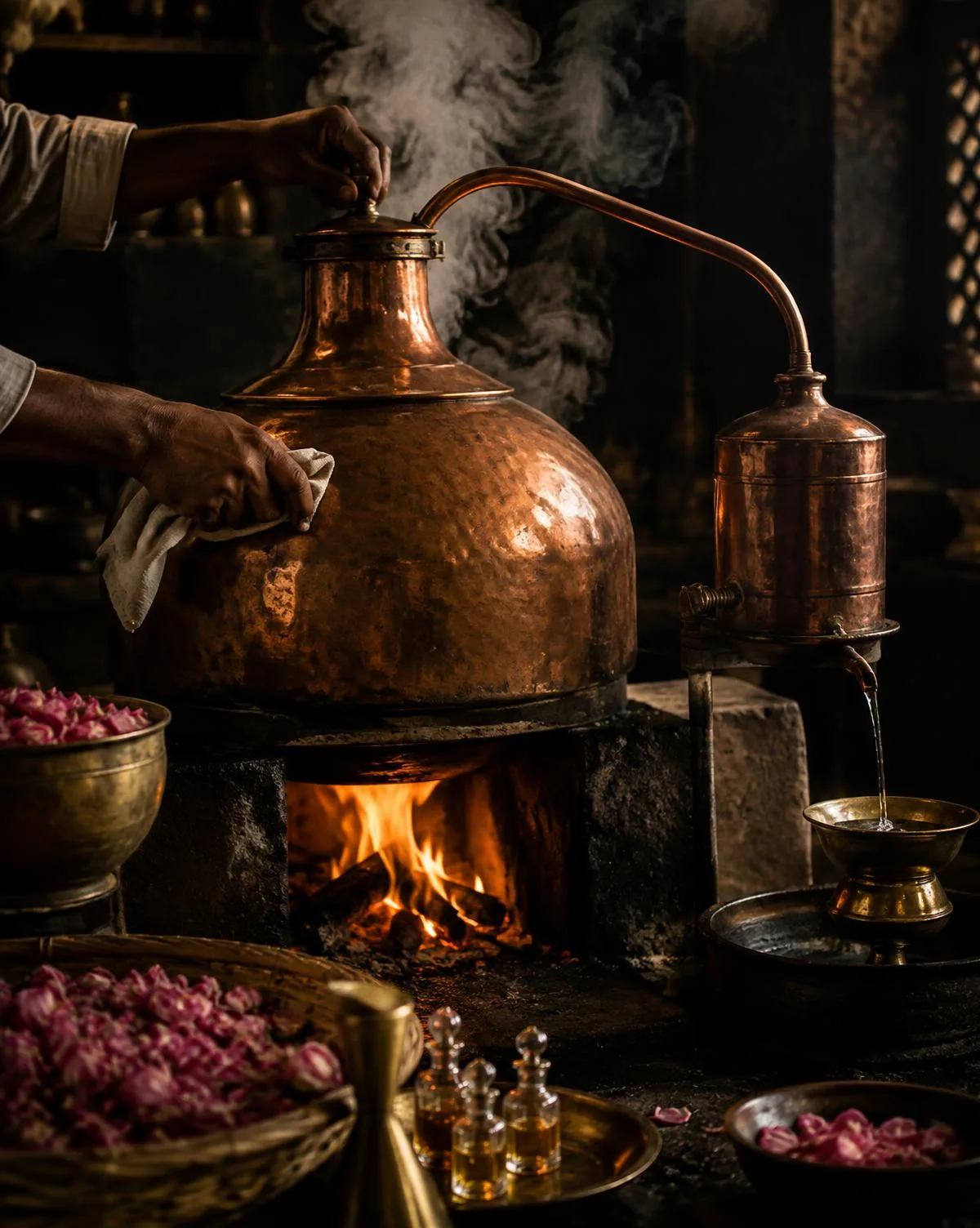
The deg and bhapka
Traditional Indian attar-making is built around a beautifully simple apparatus. Fresh botanical material and water are placed inside a copper still called a deg. Vapour travels through a bamboo-wrapped copper pipe into a receiving vessel, the bhapka, which rests in cooling water and often contains a base of sandalwood oil.
The equipment may look elemental, but controlling it requires deep experience. The distiller seals the joins, tends the fire and judges pressure by touch and sound. Too much heat can flatten delicate flowers; too little may fail to carry their full aromatic character.
Capturing a flower in oil
As aromatic vapour condenses in the bhapka, sandalwood receives and fixes the fragrant molecules. The vessel is cooled and gently moved so the distillate and oil remain in contact. Water is later separated, and the process may be repeated with fresh flowers over several rounds.
This method creates a fragrance with unusual softness and cohesion. The botanical does not simply sit on top of the base; it becomes woven into it. Rose can feel deeper, earth can feel luminous, and spices can gain a rounded warmth.
Patience after distillation
Fresh attar is only the beginning. Resting allows sharp edges to soften and the materials to harmonise. Some compositions mature for months, while special batches may be kept much longer. Air, vessel, temperature and time all influence the final balance.
Traditional attar is therefore both extraction and composition: a dialogue between raw material, fire, copper, sandalwood and the judgement of the maker. Its refinement comes not from haste, but from attention repeated over time.