
Oud guide
How to Judge the Quality of Oud Oil, and How Aging Changes It
Two bottles of oud oil can carry the same label and smell nothing alike. The difference comes from what went into the still, how it was prepared, and how the oil was treated afterward. Here is what to look at.
10 min read
1. It starts with the raw material
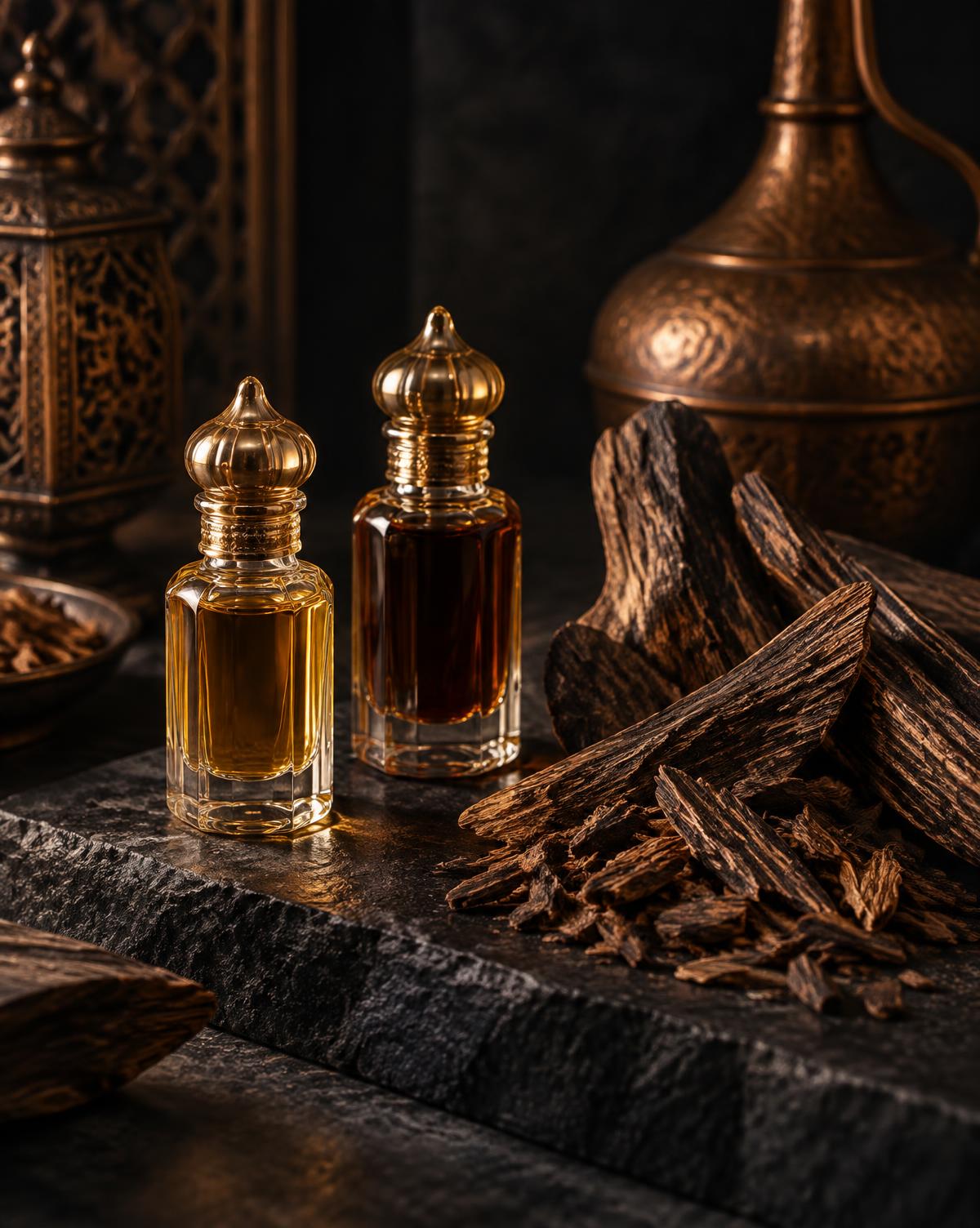
Oud oil is distilled from shavings and trimmings of resinous agarwood, a byproduct of cleaning agarwood chips. Not all shavings are equal:
- Shavings from the final cleaning are the most resinous. There is very little of this material and it is expensive, but it makes a rich, high-quality oil.
- Shavings from the initial cleaning contain far less resin and give a thinner, inferior oil.
Many commercial producers also add bunk wood, the pale, non-resinous part of the Aquilaria tree, to the shavings to increase the yield. More oil comes out, but it is diluted in character and depth.
2. Soaking shapes the character
Before distillation, shavings are soaked in water.
- Commercial oils are typically soaked for around 60 days. Soaking does not raise the yield by much, but it produces a fermented top note. This note is especially familiar in Hindi oils, and many Arab buyers love it. It actually comes from soaking the non-resinous shavings, not the resinous ones.
- Artisanal oils use a much shorter soak, because the shavings are already high quality. Less soaking means more of the oud's natural facets are left intact.
Neither approach is automatically “wrong,” but if you know where the fermented note comes from, you know what you are smelling.
3. Distillation and the timing of the cut
The most common method is hydro-distillation. Without getting too technical, the skill is in knowing when to collect. A good distiller pulls the oil as soon as it is clear that darker, more viscous oil has begun accumulating in the separating funnel. Collecting too early gives a light, watery fraction. Running too long tends to bring over heavy, harsh material that flattens the oil's complexity.
4. Curing and aging
Freshly distilled oud oil is rarely at its best. It can smell sharp, raw, smoky or sulfurous, and its facets don't blend yet, so good oil is rested before it is sold.
During aging, the oil slowly changes:
- Harsh edges soften. The rough opening mellows and the oil becomes rounder and smoother.
- The notes integrate. Woody, sweet, balsamic, leathery and animalic facets start to blend instead of competing.
- Some volatile facets fade. The oil calms down, but the lightest, most delicate notes can be lost, so aging is a trade-off.
Polymerization: why some oils thicken with age
Oud oil is rich in large aromatic molecules (sesquiterpenes and resinous compounds). Over months and years, exposure to small amounts of oxygen, along with heat and light, lets these molecules react and link together into longer chains. This is called polymerization. The results:
- The oil becomes thicker and darker.
- The molecules become heavier and less volatile, so the oil evaporates more slowly.
- Some of the original character, especially the delicate volatile facets, is lost, and the scent can turn flatter, resinous or tar-like.
Thickness is a side effect of chemistry, not a measure of quality. A thick oil can be a beautifully aged one, but it can also be an over-polymerized oil that has lost its complexity, an oil distilled too long so that heavy fractions came over, or one thickened with additives. Likewise, a thinner oil can be excellent, especially a lighter artisanal oil with many facets.
Aging refines good oil but cannot rescue a poor one. An oil made from weak shavings or a badly timed distillation will just be old, not better. It is also not true that an oil keeps improving the older it gets.
Storage matters too. Keep oud oil in a clean, airtight glass bottle, away from heat, light and temperature swings, since these speed up unwanted oxidation.
5. Why longevity is not a measure of quality
Every aromatic oil is a mix of molecules, and they differ in volatility, meaning how readily they evaporate. Smaller, lighter molecules leave quickly, while larger, heavier ones cling to the skin for hours.
- Volatile molecules are what you smell first, and they carry many of the most interesting facets: lifted, sweet, fruity, fermented, camphoraceous or animalic nuances. Some of the best aromatic molecules in oud are volatile, and they fade sooner because of what they are, not because the oil is weak.
- Heavy molecules last longest and tend to give the deep woody, balsamic, resinous base. They can be beautiful, but an oil dominated by them can smell flat and one-dimensional even if it stays on the skin all day.
So a long-lasting oil is not automatically a good one, and an oil whose best notes are fleeting is not automatically poor. Longevity mostly tells you how much heavy material the oil contains. It can even mislead, since an oil can be made to last longer with heavy fractions or added fixatives while its delicate facets are lost or diluted.
6. How to evaluate an oil yourself
- Ask about the source. A trustworthy seller can tell you the origin, the distillation date or vintage, and how the oil was made.
- Smell it at several stages. Check the bottle, then the skin after a few minutes, then after a few hours. Quality oil evolves and stays interesting, while poor oil often stays flat or turns sharp.
- Judge complexity and balance. Look for many distinct facets that work together, with no burnt, rubbery, sulfurous or chemical edges.
- Don't judge by thickness, color or staying power. These vary with the distillation, the aging and the material, and say little about quality.
- Be cautious with “aged” claims. Age is hard to verify. Ask for documentation or a clear history, and judge the oil by how it smells and develops.
- Let price inform you. Very cheap oud is almost never made from resinous shavings.
The takeaway
Great oud oil is the sum of its stages: resinous raw material, a well-judged soak, a careful distillation cut, and patient, well-stored aging. Smell, complexity and how the oil evolves tell you more than how thick it looks or how long it lasts.